
Best Moisture Meter for Roofs and Basements: A Practical Buying Guide
Get a mid-range combo meter, the kind with both pins and a pinless pad. Then use it to compare a suspect spot to a dry one. That’s most of it.
A moisture meter won’t inspect your house for you. Used right, though, it keeps you from tearing out the wrong piece of drywall, missing a wet roof deck, or calling condensation a foundation leak. Used wrong, it hands you a confident number that doesn’t mean what you think.
What to buy
If you just want an answer: a mid-range pin-and-pinless meter with a clearly labeled wood mode, a relative or masonry mode, a hold button, and a backlight. Scan walls and floors with the pinless pad. Confirm wood, drywall, and exposed sheathing with the pins. And throw a cheap hygrometer in the basement so you’re not guessing about the air.
You don’t need a full inspector’s kit. You do need to know whether the screen is showing a wood moisture-content percentage or a relative scale. Don’t pick a winner off a product photo that promises an “exact slab percentage.”
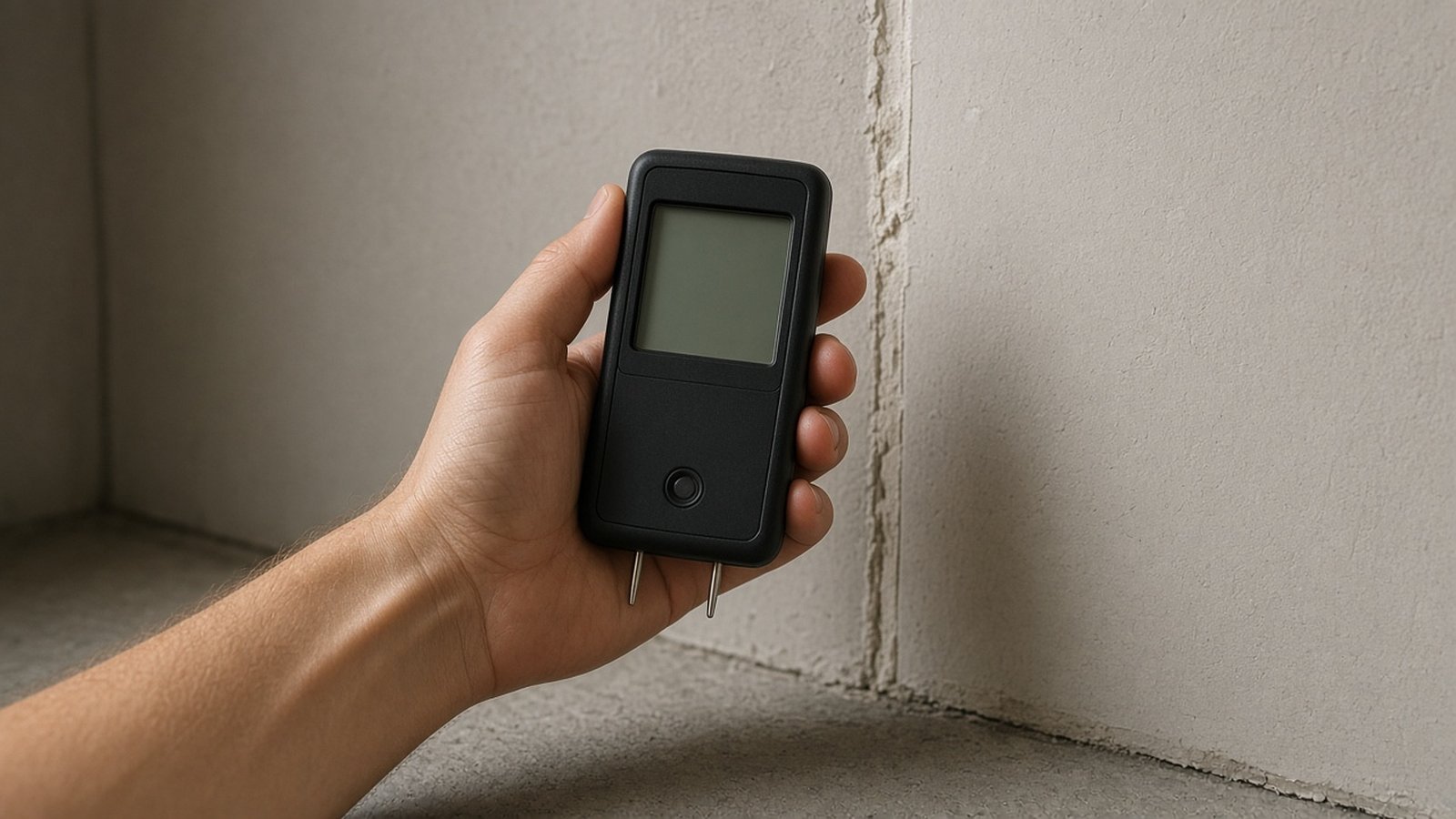
Pin meters measure resistance between two pins. They’re better when you can poke the thing you actually care about, like a bottom plate, the edge of stained drywall, or exposed roof sheathing. Usually cheaper, and more straightforward on wood. They do leave tiny holes, and they only read what the pins touch, so the vinyl or paint on top doesn’t count. Pins bend. Grab spares.
Pinless meters scan with a pad. No holes. They’re fast for sweeping basement drywall and subfloors. Depth is limited, often around 3/4 inch to an inch, so a dry surface can hide a wet layer underneath. Metal or dense layers can throw the reading off too. Keep the pad flat.
Price-wise, cheap pin meters are often in the $20 to $40 range. Mid-range combo meters commonly run about $80 to $200. Pro kits cost more, and they’re built for people writing reports. If you’re just trying to find out whether a basement corner is still wet, that’s overkill. Buy the one you’ll actually carry around.
Concrete readings and wood readings are different animals
On wood, a lot of meters show an approximate moisture-content percentage. Interior finish wood is often in the single digits to low teens, depending on your climate. If a stained piece stays much wetter than a dry piece of the same material, especially if it’s also soft or musty, you’ve got a moisture problem. Species, temperature, and the meter itself all move the number. So don’t marry one magic cutoff from a chart you never checked against your own tool.
Concrete and block are trickier. Many meters only give a relative reading there. A 20 on one wall and a 40 on another? Useful. Reading that 20 as “20% moisture,” like it’s a stud? Wrong. If a cheap pin meter claims precise slab percentages, I’d be skeptical.
Some flooring makers want a specific test that a handheld meter can’t replace. In that case your meter is just a first screen. It doesn’t sign off on anything.
Checking a roof: do it from the attic
Scanning the top of asphalt shingles is tempting. It’s also usually disappointing. You’re reading a layered, uneven mess, and morning dew will confuse it. Don’t get on the roof to chase a number, especially if the deck might be soft or damaged.
Go up in the attic instead. Bring a headlamp. Step on the joists, never the insulation between them.
Look before you measure. Stains, rusty nails, damp insulation, daylight. Then take a reference reading on a clearly dry patch of the same sheathing and compare it to the suspect spots. Valleys, eaves, chimney chases, skylight curbs, and anything under a roof penetration are the usual places to check. Use the pins on exposed wood when you want to confirm.
If the deck reads wet or feels soft, stay off the roof and call a roofer. Wet sheathing is a roofer’s job, and a shingle patch from up top won’t fix it. The meter’s job here is to find the problem and document it from the attic. It should never be your reason to go walking on bad decking.
In the basement
Timing matters as much as the meter. After a storm, check baseboards, the bottom of the drywall, bottom plates, stair stringers, and any stain. On a humid day with no rain, check those same spots plus cold walls, rim joists, and around windows.
Always take a reference reading on the same material where it looks dry. Hold the pins or pad still until the number settles, and hit the hold button if you’re stuck in a dark corner. One wild number can just be a nail or screw behind the surface. Move over an inch and check again.
Scan with pinless. Confirm wood and drywall with pins.
And look behind the boxes stored along exterior walls. That’s where leaks and condensation like to hide.
Wondering whether a “fixed” leak is really fixed? Check again after the next rain and see whether the readings dropped. Thinking about finishing the space or putting down flooring? Don’t trust one dry afternoon. Check again in wet weather.
FAQ
Can I use a moisture meter from the top of the roof?
Don’t go up on the roof to use it. Shingle layers confuse a lot of meters anyway, and walking a roof, especially one that’s damaged or might be soft, is a real risk. Look from the ground first, then use the meter from the attic.
What number means wood is “too wet”?
Depends on the wood, the house, and the climate. Compare the suspect piece to a dry piece of the same material and look at its condition. If the reading stays high and the wood is stained, soft, or musty, treat it as wet. Don’t hang the whole decision on one chart.
Do I need a special meter for concrete?
You need one with a relative or masonry mode, and you need to treat the result as a comparison. It won’t give you a precise percentage. Some flooring jobs also require a different test than any handheld meter can do.
Will a moisture meter detect mold?
No. It detects moisture, which is one thing mold needs. Visible growth, a smell, and a confirmed wet source are separate questions. If you’ve got a big or stubborn mold problem you can’t handle safely, bring in someone who can.
Is a cheap meter better than nothing?
Yes, as long as you use it to compare two spots and don’t over-trust the number. A $20 to $40 pin meter can tell you a stained baseboard is still wet. It’s weaker for scanning walls or judging a slab. If you’ll be using it in basements and attics, a mid-range combo meter is usually worth the extra money.